

In 2026, GST compliance is more strict, more digital, and more automated than ever before. Businesses of all sizes must create GST-ready invoices that follow late rules and technical requirements. Even small mistake can lead to invoice rejection, delayed payment, penalties or compliance notices.
If you are business owner, accountant, freelancer or startup founder, it’s mandatory to understand GST invoice rules. GST-ready invoice is not just document it is financial identity of your business and when prepared correctly, it supports compliance, strengthens trust with customers and protects long-term growth.
Let’s understand what GST-ready invoice is, invoice rules in 2026, what leads to invoice rejection, and how to avoid mistakes in 2026 using invocreto invoicing software.
What is GST-Ready invoice in 2026?
GST-ready invoice is an invoice that follows all Goods and Services Tax rules and is formatted according to latest government requirements.
GST system is now highly automated. Most invoices are verified digitally. The invoice must be include all mandatory details, data you enter matched with GST portal records, E-invoice portal (if applicable), Buyer’s GST returns, E-way bill data and if anything does not match
Why GST invoice accuracy matters
The GST system today works on automated data matching, invoice details reported in GSTR-1 are matched with buyer’s GSTR-2B and if there is any mismatch in GSTIN, taxable value, tax amount or place of supply the system will flag it instantly.
Now process is digital and quick, this automation means errors are detected instantly, and corrections must be made without any delay. In many cases, businesses lose credibility when their invoices are repeatedly rejected. Incorrect GST-ready invoices can cause serious problems:
- Input tax credit (ITC) rejection for buyers
- Delayed payments from customers
- GST return mismatch notice
- Penalties and interest charges
- Compliance rating impact
What makes an invoice GST-ready
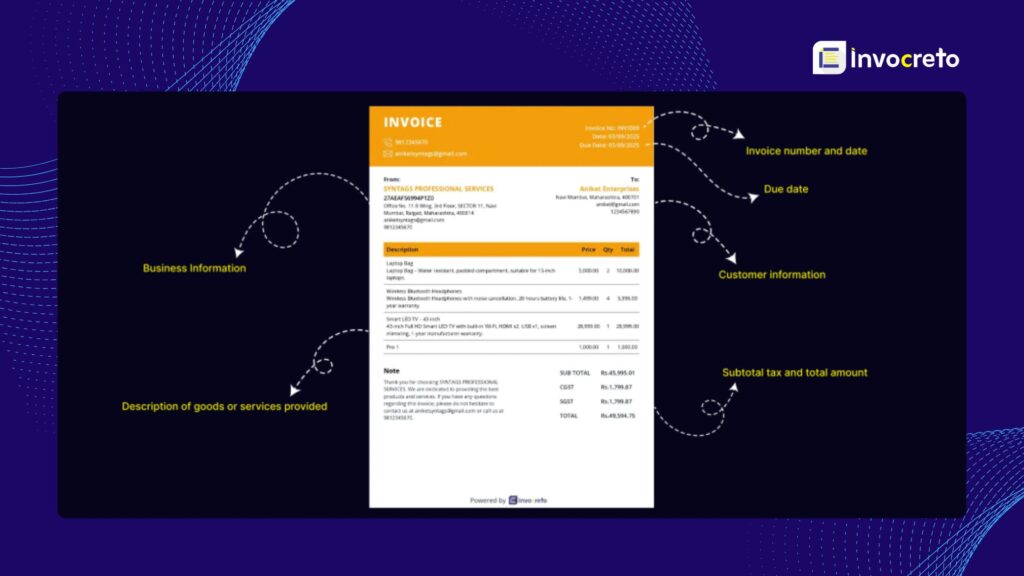
A GST-ready invoice includes all mandatory details and follows classification and tax rules. GST compliant invoice should include:
- Invoice number
- Invoice date
- Supplier address
- Suplier GSTIN
- Buyer name
- Buyer address
- Buyers address
- Buyer GSTIN (if registered)
- HSN/SAC code
- Description of goods or services
- Quantity and unit
- Taxable value
- GST rate (CGST, SGST, IGST)
- Tax amount
- Total invoice value
In case business falls under e-invoicing requirements, invoice must be registered on portal and have valid IRN and QR code. But most importantly, invoice must match data filed in GST returns
If you are running business, sometimes you feel overwhelmed to add all details for multiple invoices, Instead of doing everything manually, you can make greate move of switching to invoice software that makes process simple and fast
With invocreto invoicing software, you can generate GST-ready invoices instantly. System automatically checks your entries and alerts you if any important details are missing. It saves your business information, customers details and tax settings so you don’t have to fill them in every time. You can easily convert orders into invoices in just one click and create, manage, track multiple invoices and there payment in one place. The software helps you prepare clear and accurate invoices, which reduces chances of mistakes between your books of accounts and GST filings.
Impact of accurate GST invoicing
- Accurate invoices improve cash flow. When buyers payments are processed faster if they do not have ITC issues. This reduces working capital pressure and supports smooth business operations.
- Companies prefer to work with vendors who file returns on time and issue proper invoices. Clean & good compliance records build trust, credibility and open doors to larger contracts.
- During audits or assessments, businesses with accurate documentation and GST-ready invoices experience less stress. Clear and well-maintained records reduce risk of disagreements. This allows management to focus on expansion rather than compliance worries
- Proper invoicing also helps in financial planning. When tax liability is correctly calculated and ITC is accurately tracked, businesses can plan expenses and investments more confidently
Common mistakes that lead to GST invoice rejections
Sometimes, even experienced businesses make small errors. These errors may look minor but can create compliance issues.
- One common mistake is entering an incorrect GSTIN. Single wrong digit can prevent buyer from claiming input tax credit.
- Another frequent issue is incorrect tax calculation. Applying CGST and SGST instead of IGST for interstate transactions or misclassifying place of supply can result in tax mismatch.
- Using wrong HSN or SAC code is also major reason for rejection. Tax rates depend on correct classification and when classification is wrong it may lead to underpayment or excess payment of tax.
- Some businesses forget to maintain proper invoice number sequence. Duplicate invoice numbers or irregular numbering patterns can cause system-level rejection. GST framework expects unique invoice number for each financial year.
- Mistach between accounting records and GSTR-1 filing is also growing concern. If sales data in books does not match return filings, reconciliation becomes difficult.
How to reduce GST invoice rejections in 2026
Using GST-compliant accounting software is highly beneficial. Reducing GST-ready invoice rejections becomes much easier when you use invoicing software instead of manual methods. A structured digital system minimizes errors and ensures every invoice follows GST rules.
Invoicing software automatically calculates tax based on the place of supply and applies the correct GST rates. It generates proper invoice numbers in structured format and ensures that all mandatory fields are completed before the invoice is finalized. This built-in validation greatly reduces the chances of mistakes that can lead to rejection.
The software also helps by keeping your records organized and ready for reconciliation. It allows you to match sales data with GST returns regularly, helping you identify mismatches early. When issues are detected quickly, they can be corrected before filing, preventing bigger compliance problems later. Customer GSTINs, HSN codes, tax rates, and product details are saved securely and can be updated whenever required. This make sure that invoices are always created using accurate and updated information.
By using invoicing software, businesses create a strong compliance framework. It improves accuracy, saves time, reduces rework, and ensures that GST-ready invoices are prepared correctly every time.
Turing Compliance into business advantage
Compliance should not be seen as a burden or just legal requirement. Instead, it should be treated as a structured business practice that builds stronger internal systems and improves overall efficiency. When you have GST-ready invoices, reporting becomes simple and stress-free. When reporting is simple, management becomes clear and reliable information. And when clarity improves, decision-making becomes faster and more confident. This chain reaction helps business owners stay in control of their finances and operations.
Compliance also reduces the risk of penalties, notices, and unnecessary audits. When your GST records match your books of accounts, filing returns becomes smooth and organized. This saves time for your finance team and lowers stress during tax periods.
Businesses that focus on accuracy and structured processes today find it much easier to scale in the future. Growth requires strong systems, clear records, and reliable data. GST-ready invoicing is one of the key systems that support stable growth. It creates solid foundation for expansion, better financial planning, and improved cash flow management.
Looking ahead: Future of GST compliance
The GST framework is expected to become more technology-driven in the coming years. Artificial intelligence tools can identify mismatches automatically. Real-time data sharing could become more common. As compliance becomes smarter, businesses must also become smarter in their processes.
Those who invest in digital accounting tools, training, and regular review systems will stay ahead.
Final thoughts
In 2026, GST-ready invoices are not just about following rules. It is about maintaining accuracy, discipline, and being digitally prepared. Most invoice rejections happen because of small and avoidable mistakes, and these errors can be prevented by using reliable invoicing software.
Invoicing software helps to make correct GSTIN entry, accurate tax calculation, proper product classification, and structured invoice formatting. It automatically checks required fields before generating the invoice, reducing the chances of missing or incorrect information. Built-in validation features help businesses stay aligned with GST regulations without depending fully on manual review. Strong digital systems make expansion easier. When your invoicing process is automated and structured, you can handle higher transaction volumes without confusion or errors.

No comments yet