

Many people think that billing process is simple task just create invoice and send it to customer. But anyone running business knows that billing is rarely that simple. You need to collect right customer details, check GSTIN, add correct products or services, select right HSN or SAC code, calculate GST, create invoice, send it to customer, track payments, and keep records ready for accounting.
When these tasks are handled manually, mistakes can happen and become extra work. Wrong GSTIN leads to invoice correction. A missed payment can affect cash flow, incorrect tax calculation can create accounting problems, and when invoices are spread across Excel files, emails and WhatsApp chats, finding right information can take time.
That is why good business billing process should cover complete journey from creating invoice to receiving and recording payment.
What should business billing process include?
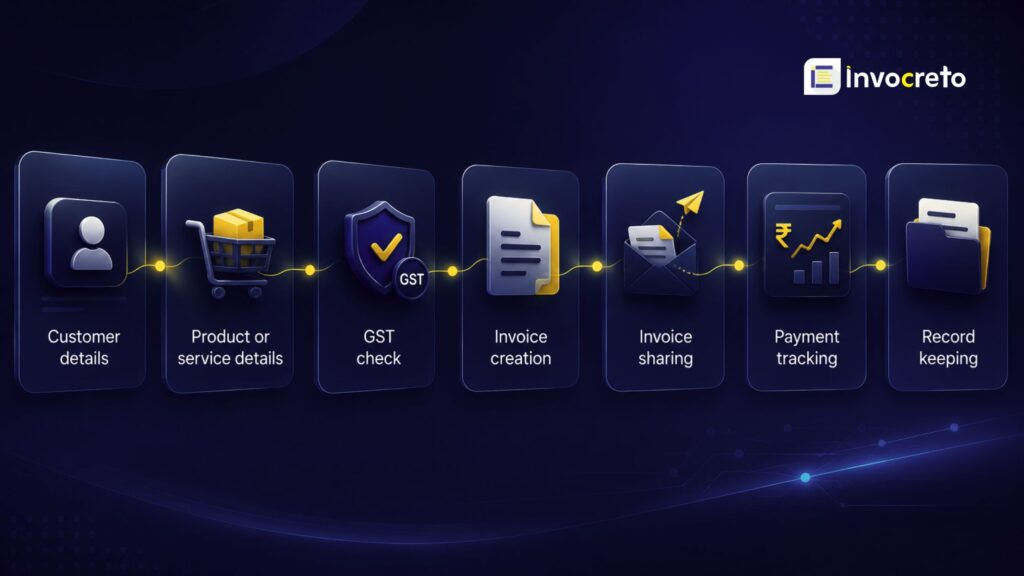
A complete billing process can be divided into seven simple stages:
Customer details – product or service details – GST check – invoice creation – invoice sharing – payment tracking – record keeping
1. Start with correct business details
Before creating an invoice, make sure your business information is correct:
Depending on your business and tax status, this includes:
- Business or legal name
- Business address
- GSTIN, if applicable
- PAN
- Contact details
- State and state code
- Bank details
- Payment information
If same information is entered manually for every invoice, there is always chance of typing mistake. Digital invoicing system can reduce this repetitive work by saving your business details and using them when new invoices are created. Invocreto allows businesses to set up their business information once and use saved details while preparing invoices. This is useful for SMEs that create invoices regularly and do not want to repeatedly enter the same information.
Simple rule: set up your business details once, but review them whenever your GST, address or other important information changes.
2. Check your customer details before creating invoice
Customer information is just as important as your own business information. Before billing check:
- Customer name
- Company name, if applicable
- Billing address
- Shipping address, if different
- GSTIN, where applicable
- State
- Purchase order number
- Contact details
- Payment terms
For B2B transactions, customer’s GSTIN is especially important. Entering GSTIN from old email or copying it from previous invoice without checking can create avoidable problems.
Use GSTIN verification tool when needed: invocreto includes GSTIN Search that can help businesses check GST registration details before preparing invoice. This is more useful when adding new business customer the important point is that verification should happen before invoice is finalised.
3. Follow consistent invoice numbering system
Every invoice should have clear and unique invoice number. Exact format can be different but your numbering system should be consistent, for example:
- INV/26-27/001
- INV/26-27/002
- INV/26-27/003
This invoice number formatting help you:
- Find invoices quickly
- Match payments
- Identify missing invoices
- Maintain accounting records
- Handle corrections
- Answer customer questions
GST rules require invoice numbers to be unique and in continuous sequence for relevant financial year as per applicable rules. Billing system can make this billing process easier by creating invoices in one place, instead of managing invoice numbers manually in different files. Invocreto invoicing software offers different invoice number formats that you can choose based on your preference. Every invoice is GST-ready and includes accurate invoice numbering.
4. Clearly mention what you are selling
Invoice should tell customer exactly what they are paying for so add description of product or service you are providing. Clear descriptions make invoices easier for customers, accounts and business owners to understand. Avoid descriptions that are too general.
For example:
Less useful:
Consulting – ₹25,000
Better:
Business consulting services – July 2026
For products, you may need:
- Product name
- Quantity
- Unit
- Price
- Discount
- HSN
- GST rate
For services, you may need:
- Service description
- Service period
- SAC
- Quantity or hours, where relevant
- Rate
- GST rate
5. Check HSN or SAC code
HSN code and SAC codes are another important part of billing
- HSN code is used for goods.
- SAC code is used for services
The correct code depends on goods or services are being sold. Businesses often use codes from old invoices, but this can cause problems if products or services change or if code needs to be updated. To simplify this invocreto provides HSN/SAC finder that helps users find relevant codes while creating invoices. For common products and services, this can save time compared to checking long lists of codes manually.
6. Calculate GST carefully
Tax calculation is one of the most important parts of billing, before sending invoice check:
- Taxable value
- GST rate
- CGST
- SGST/UTGST
- IGST
- Discount
- Cess, where applicable
- Round-off
- Final invoice amount
If taxable value is wrong, GST calculation will also be wrong. This is why use invoicing software that has automation for GST calculations or you can use GST calculator tool.
7. Make sure your invoice has required GST details
GST invoice is more than document showing amount to be paid. Depending on transaction, invoice may need details such as:
- Supplier name and address
- Supplier GSTIN
- Invoice number
- Invoice date
- Customer details
- Customer GSTIN, where applicable
- Place of supply
- HSN/SAC
- Description of goods or services
- Quantity
- Taxable value
- GST rate
- Tax amount
- Other prescribed information
This is where using structured invoicing system is important. Instead of adding every details then designing every invoice manually use invoicing platform that provides standard GST format invoice and reduces chance of leaving important fields blank.
8. Send invoice through convenient channel
Creating invoice is only one part of billing. Customers also need to receive it. Common options include:
- Customer portals
- Printed invoices
For many Indian SMEs, WhatsApp is already a common way to communicate with customers. This makes WhatsApp invoicing a simple and practical option for businesses. That’s why invocreto comes with solution, introducing India’s first WhatsApp invoicing feature where you can create invoice on WhatsApp, share it on WhatsApp with payment link and get paid; all on WhatsApp.
This will be more useful for businesses such as Freelancers, Consultants, Local service providers, Small retailers, Traders, Agencies, and independent professionals. The benefit is not just about sending an invoice on WhatsApp, main advantage is that it reduces steps between creating invoice and sending it to customer.
9. Give customers an easy way to pay
An invoice should make next step clear. Customer should know:
- How much do I need to pay?
- When do I need to pay?
- How can I pay?
Payment options may include:
- UPI
- Bank transfer
- Cards
- Net banking
- Payment links
- Other methods accepted by the business
Software with payment integration will be more beneficial for this situation. Business just needs to share payment link and customer can pay with multiple options like UPI, cards, net banking and wallets.
10. Track every invoice after sending
This is one of the most important parts of business billing. Many businesses are good at creating invoices but not as good at tracking them because there are lot of invoices to track. Simple invoice tracker should tell you whether an invoice is:
- Draft
- Sent
- Partially paid
- Paid
- Overdue
- Cancelled
- Adjusted
Without this information, it is easy to forget outstanding invoices. Invocreto provides customer and invoice management features that help businesses track unpaid invoices and overdue payments. This turns billing into more complete process:
Create → Send → Track → Follow up → Receive payment
For SEM and MSME, this visibility can be especially useful because unpaid invoices directly affect working capital and day-to-day cash flow.
11. Keep payment terms clear
Never leave payment terms unclear. Instead of ‘payment as discussed’, write ‘payment due within 30 days from invoice date. Your invoice can include:
- Payment due date
- Credit period
- Bank details
- UPI details
- Payment link
- Late-payment terms, where applicable
For eligible micro and small enterprise suppliers, MSMED Act has specific provisions relating to payment periods and delayed payments. Where written period is agreed, Act provides that it cannot exceed 45 days from date of acceptance
12. Keep customer and payment history organised
As business grows, remembering every customer transaction becomes difficult. You may want to know:
What did this customer buy?
Which invoices are unpaid?
How much does the customer owe?
When did the customer last pay?
Which invoices are overdue?
Invocreto’s customer management features help businesses keep customer details, invoices, and payment information organised in one place. The benefit is more than just storing names and phone numbers. Businesses can also keep customer details and billing history together, making it easier to track payments, invoices, and overall customer activity.
13. Review your billing every month
Good billing system still needs regular review, so at end of every month check:
Customer details
☐ Customer information is correct
☐ GSTINs are checked where applicable
☐ New customers are added properly
Invoice details
☐ Invoice numbers are in sequence
☐ Invoice dates are correct
☐ Product/service descriptions are clear
☐ HSN/SAC details are appropriate
☐ GST calculations are correct
☐ Invoice totals are correct
Payments
☐ All invoices have been sent
☐ Paid invoices are recorded
☐ Partial payments are identified
☐ Overdue invoices are listed
☐ Payment follow-ups are completed
Compliance
☐ GST requirements are reviewed
☐ E-invoice applicability is checked
☐ Credit/debit notes are recorded
☐ Required records are maintained
Accounting
☐ Sales records are updated
☐ Payment records are matched
☐ Refunds and adjustments are recorded
☐ Accounting data is backed up
Simple billing process for Indian SME’s and MSME’s
Step 1
Add the customer: Save the customer’s basic information.
Step 2
Check the GSTIN: Verify the GSTIN when applicable.
Step 3
Add your product or service: Keep frequently used items saved for faster billing.
Step 4
Check HSN/SAC: Use the appropriate classification.
Step 5
Calculate GST: Confirm the applicable tax treatment and calculate the invoice correctly.
Step 6
Create the invoice: Check all important details before finalising it.
Step 7
Send the invoice: Use email, WhatsApp or another suitable channel.
Step 8
Collect payment: Provide clear payment instructions or a payment link.
Step 9
Track payment: Know which invoices are paid, pending or overdue.
Step 10
Record the transaction: Keep your accounting and supporting records updated.
Final thoughts
A good billing process is not just about creating invoices quickly. It is about making sure the right invoice reaches the right customer with the correct information at the right time. It is also important to track the payment after the invoice is sent.
For Indian SMEs and MSMEs, a simple billing process can look like this:
Verify → Create → Calculate → Send → Collect → Track → Record
The right digital tools can make each step easier. Invocreto brings these tasks together in one place, including invoice creation, GST calculator, GSTIN search, HSN/SAC finder, customer management, WhatsApp invoicing, and payment tracking. The goal is to automate everything to reduce repetitive work, avoid common billing mistakes, keep payment details organised, and make daily business tasks easier. For small business owners, this can make a real difference.
Better billing process is not just about sending invoices. It is about having a simple billing process that is easy to understand, manage, and trust every day.

No comments yet