

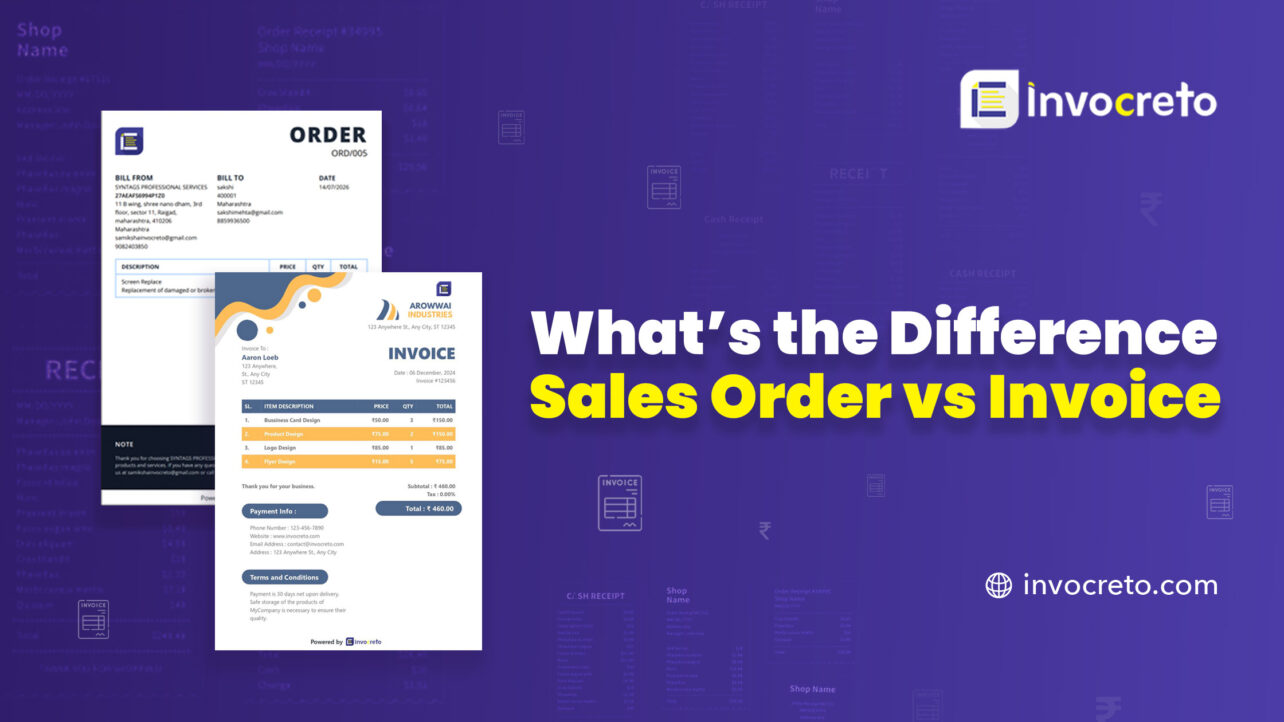
Short answer: A sales order confirms the details of customer’s purchase and helps seller organize fulfillment, and invoice is billing document that tells the customer how much is due and when to pay. A sales order is primarily connected to the order and fulfillment process; an invoice is connected to billing, accounts receivable, tax records, and payment.
Both are different documents but both can contain similar information such as products, quantities, prices and customer details. They serve different purposes and appear at different stages of the sales process.
Understanding the difference between a sales order vs. invoice is important for accurate order management, inventory control, bookkeeping, cash flow, and tax compliance.
Sales Order vs. Invoice: Quick Comparison
| Main purpose | Confirms and manages a customer order | Requests payment for goods or services |
| Usually created | Before or during fulfillment | When the business has a billing trigger |
| Focus | What the customer ordered | What the customer owes |
| Used by | Sales, operations, warehouse, fulfillment | Finance, accounts receivable, customer |
| Payment trigger | Usually does not itself request payment | Yes, it states the amount payable and terms |
| Accounting impact | Typically a non-posting operational document | Typically posts or supports an accounts receivable transaction when issued/posted |
| Inventory role | Can support fulfillment and inventory planning | Usually follows or references fulfillment/billing information |
| Tax/compliance role | Generally not the tax invoice | May be a tax invoice where applicable |
| Can be converted into | Delivery/shipment and/or invoice | Payment/receipt and accounting records |
What Is a Sales Order?
A sales order (SO) is a document created by a seller to record and manage a confirmed customer order. It generally contains information such as:
- Customer name and contact details
- Products or services ordered
- Quantities
- Agreed prices
- Discounts
- Delivery or fulfillment information
- Customer purchase order reference, where applicable
- Payment or commercial terms
- Requested delivery dates
- Shipping information
The main purpose of a sales order is to answer: “What have we agreed to provide to this customer?”
Once created, the sales order can help different teams coordinate what happens next. The warehouse may use it to prepare goods, procurement may use it to plan inventory, and service teams may use it to organize project delivery.
Example of a Sales Order
Imagine a company orders:
- 50 laptops
- Price: ₹50,000 each
- Delivery: Within 15 days
- Payment terms: 30 days
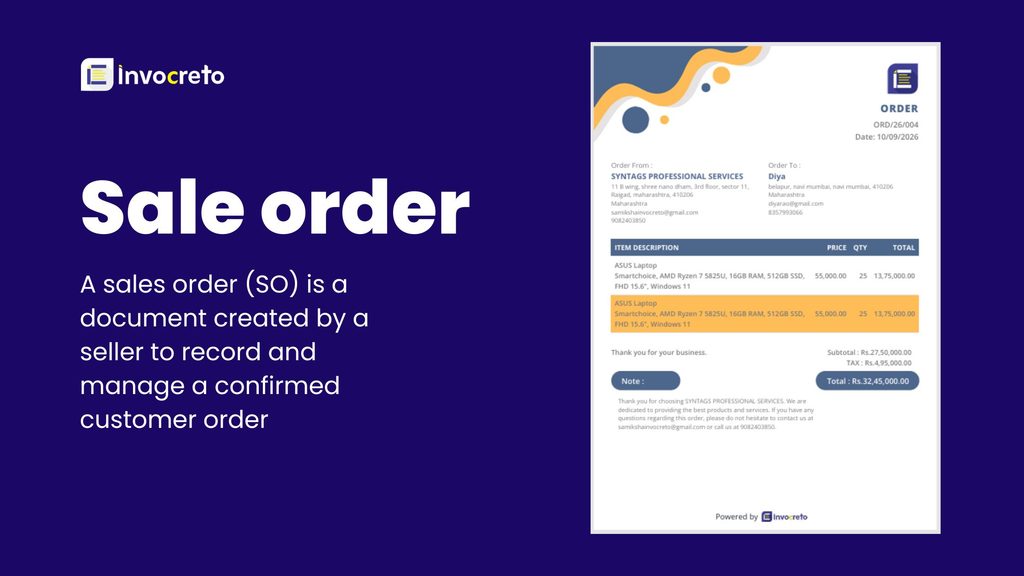
The seller can create an order invoice confirming these details. At this stage, the business knows what it has committed to fulfill. The actual invoice may be generated later, depending on the agreed billing terms and fulfillment process.
What Is an Invoice?
An invoice is a document issued by a seller to communicate the amount a customer is required to pay for goods or services. An invoice normally includes:
- Invoice number
- Invoice date
- Seller information
- Buyer information
- Description of goods or services
- Quantity
- Unit price
- Discounts, where applicable
- Tax details
- Total amount
- Payment terms
- Due date
- Payment instructions
- Relevant purchase order or order invoice reference
The main question an invoice answers is: “How much does the customer owe, and when is payment due?”
example:
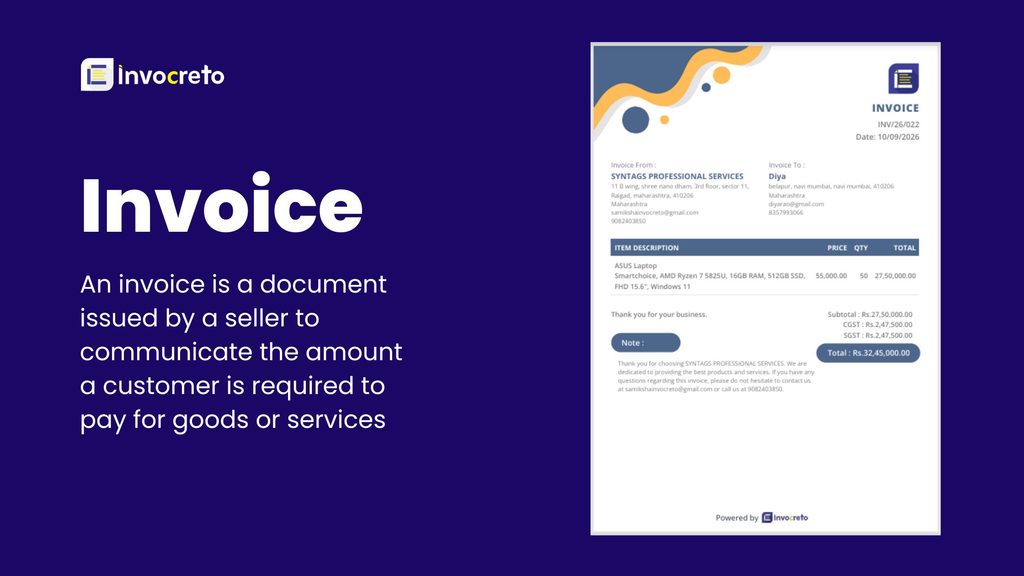
Unlike a sales order, an invoice is directly connected with billing and receivables. Invoices are also important records for accounting, audits, and applicable tax reporting. Salesforce similarly distinguishes the invoice as the payment request that follows the sales order process.
Sales Order vs. Invoice: The 7 Key Differences
1. Purpose: The biggest difference is purpose. A sales order confirms and manages the sale. An invoice bills the customer sales order is the operational roadmap and the invoice is the financial request for payment.
2. Timing: A order invoice generally appears earlier in the order-to-cash process. A typical workflow looks like: Quotation → Customer approval/order → Sales Order → Fulfillment/Delivery → Invoice → Payment,
but this is not a universal sequence. Businesses may invoice before delivery, at milestones, on a recurring schedule, or when an advance becomes due, depending on the contract and applicable rules. SAP, for example, documents scenarios where invoices can be created with reference to a sales order, including advance-payment situations.
3. Primary Users:
Orders invoice are especially useful to:
- Sales teams
- Operations teams
- Warehouse teams
- Procurement teams
- Production teams
- Logistics teams
Invoices are primarily used by:
- Finance teams
- Accounts receivable teams
- Customers
- Tax/accounting teams
4. Accounting Treatment: A sales order is generally an operational or commercial document rather than a posted accounting transaction. An invoice, when issued or posted in an accounting system, can create the customer’s accounts receivable balance and affect financial records according to the organization’s accounting setup. This is why confusing order invoice with an invoice can create problems in financial reporting.
5. Payment: A sales order may contain payment terms, but its central function is not to collect payment. An invoice is specifically designed to communicate: amount due + payment terms + due date + payment instructions. For example, a sales order might state that the customer agreed to “Net 30” terms. The invoice is generally what establishes the specific bill and payment due date within the billing workflow.
Inventory and Fulfillment: Sales orders can be closely connected to inventory and fulfillment. For example, a sales order for 500 units can help a company determine:
- How much inventory needs to be reserved
- Whether additional stock must be purchased
- What needs to be shipped
- Which orders are pending
- Which orders have been partially fulfilled
An invoice primarily records the billing side of the transaction.
7. Tax and Compliance: This is one of the most important differences. A sales order should not automatically be treated as a tax invoice. Where tax laws require a tax invoice, the invoice must contain the applicable statutory information. For example, under India’s GST framework, tax invoices have specified requirements. GST e-invoice guidance lists information including supplier and recipient details, invoice number and date, HSN/SAC information, taxable value, tax rates and amounts, place of supply where applicable, and other prescribed fields.
Final Takeaway
The simplest way to remember the sales order vs. invoice difference is:
A sales order is about the order. An invoice is about the money.
The sales order helps a business understand what the customer has ordered and what needs to be fulfilled. The invoice communicates what the customer is being billed for, how much is due, and when payment is expected.
For simple transactions, a business may be able to invoice directly. But when sales involve inventory, partial shipments, multiple deliveries, projects, approvals, or complex commercial terms, sales orders provide an important layer of control between the sale and the bill.
When the two documents are connected in an accounting or ERP system, businesses gain a clearer trail from customer commitment → fulfillment → billing → payment. That connection is the real value of understanding the difference between a sales order and an invoice.

No comments yet