

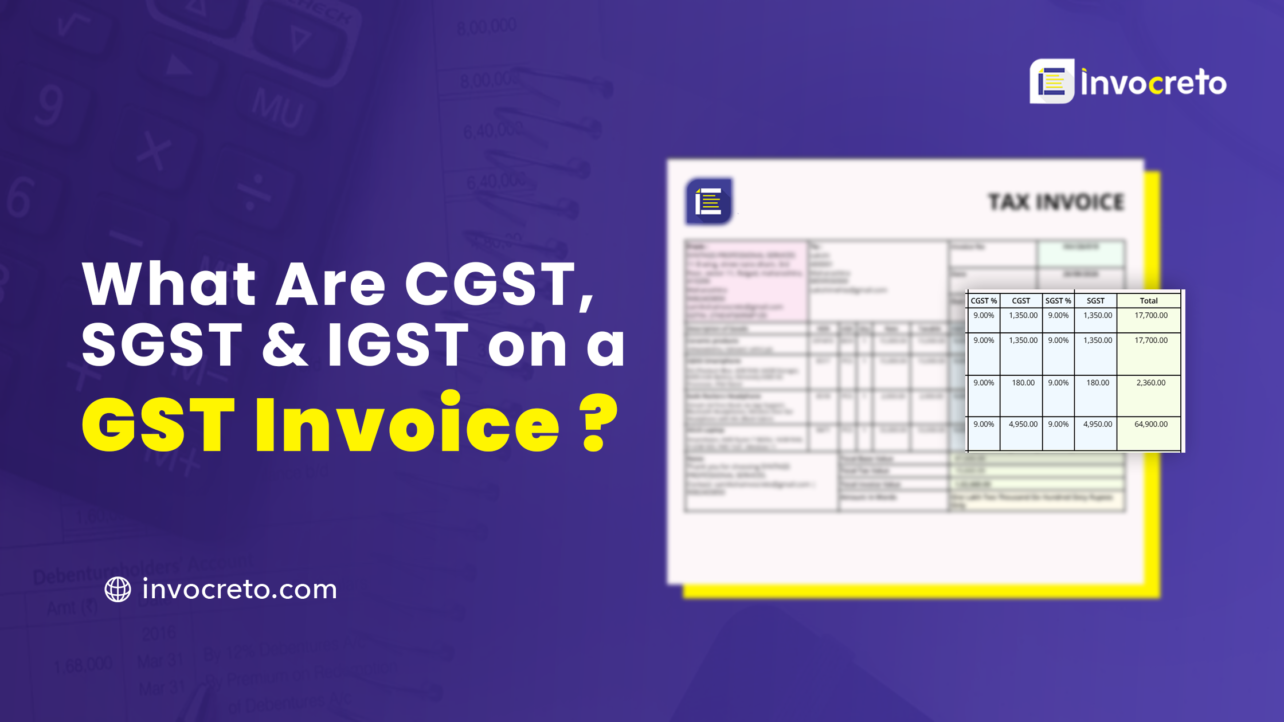
The Goods and Services Tax (GST) system differs based on whether a sale happens within a single state or crosses state borders. In a GST invoice, CGST, SGST, and IGST are the different components used to show GST charged on a sale.
A small mistake in GST calculation can lead to an incorrect invoice, wrong tax reporting, payment differences, and extra work during reconciliation. This is why understanding basic difference between CGST, SGST, and IGST is important for every GST registered business.
What Are CGST, SGST, and IGST?
GST, or Goods and Services Tax, is an indirect tax charged on supply of goods and services in India. Depending on whether transaction is within same State/UT or between different States/UTs, different components of GST may apply.
The three important GST components are:
- CGST: Central Goods and Services Tax
- SGST: State Goods and Services Tax
- IGST: Integrated Goods and Services Tax
The basic rule is simple:
- Intra-State supply: CGST + SGST/UTGST
- Inter-State supply: IGST
What Is CGST?
CGST stands for Central Goods and Services Tax. CGST is collected by the Central Government on an intra-State supply of goods or services. It is charged along with SGST or UTGST when the transaction qualifies as an intra-State supply.
For example, suppose a GST registered business in Maharashtra sells taxable goods to a customer where the supply is treated as an intra-State supply in Maharashtra.
If GST applicable GST rate is 18%, tax is generally divided
- CGST: 9%
- SGST: 9%
If the taxable value is ₹10,000:
- CGST = ₹900
- SGST = ₹900
- Total GST = ₹1,800
- Invoice value = ₹11,800
The important point is that the 18% GST rate has not become 36%. The 18% is simply divided into two components of 9% each.
What Is SGST?
SGST stands for State Goods and Services Tax. SGST is the State Government’s component of GST on an intra-State supply. It is normally charged together with CGST.
Using the same example:
- Taxable value = ₹10,000
- GST rate = 18%
The GST is split into:
- 9% CGST = ₹900
- 9% SGST = ₹900
Therefore, the customer pays ₹1,800 as total GST. For certain supplies involving Union Territories, UTGST may apply instead of SGST, depending on the applicable rules.
What Is IGST?
IGST stands for Integrated Goods and Services Tax. IGST generally applies to inter-State supplies. It is also relevant to certain other transactions, including imports and exports, subject to the applicable GST rules.
For example, assume a business in Gujarat makes an inter-State taxable supply to a customer in Maharashtra. If the applicable GST rate is 18%, the invoice would generally show:
- Taxable value: ₹10,000
- IGST @ 18%: ₹1,800
- Total invoice value: ₹11,800
In this case, the invoice does not normally split the 18% into CGST and SGST. Instead, the complete applicable GST is shown as IGST.
Differences between CGST vs SGST vs IGST
| GST Component | Full Form | Usually Applies To | Example at 18% GST |
| CGST | Central Goods and Services Tax | Intra-State supply | 9% |
| SGST | State Goods and Services Tax | Intra-State supply | 9% |
| IGST | Integrated Goods and Services Tax | Inter-State supply | 18% |
The exact GST rate depends on the goods or services involved. GST rates are not the same for every product or service, so businesses should verify the applicable rate before issuing an invoice.
How Do You Know Whether to Charge CGST + SGST or IGST?
This is one of the most important GST invoice questions. The answer is not based only on the customer’s billing address. The place of supply rules under GST need to be considered. Example:
Same-State transaction
A supplier in Gujarat makes a taxable supply that is treated as an intra-State supply in Gujarat.
CGST + SGST
Different-State transaction
A supplier in Gujarat makes a taxable supply to a customer in Maharashtra, and the transaction is treated as an inter-State supply.
IGST
How Is GST Calculated on an Invoice?
GST Amount = Taxable Value × GST Rate ÷ 100
Example:
Taxable value = ₹25,000
GST rate = 18%
GST = ₹25,000 × 18% = ₹4,500
If the supply is intra-State:
CGST @ 9% = ₹2,250
SGST @ 9% = ₹2,250
If the supply is inter-State: IGST @ 18% = ₹4,500
Why Do GST Invoice Calculation Errors Happen?
Choosing the Wrong GST Type
Business may accidentally select CGST and SGST when IGST should apply, or select IGST when transaction is intra-State. This is why supplier’s State and place of supply should be checked before finalizing the invoice.
Using the Wrong GST Rate
GST rates can differ between goods and services. If wrong rate is selected, even perfectly calculated invoice can have the wrong tax amount.
Calculating GST on the Wrong Value
If the taxable value is wrong, GST amount will also be wrong. For example, calculating 18% on ₹25,000 when the correct taxable value is ₹23,000 will result in an incorrect tax amount.
Splitting CGST and SGST Incorrectly
For a normal 18% intra-State supply, the tax is generally split into: 9% CGST + 9% SGST
How to avoid these mistakes
Manual calculations and repeated data entry can make invoicing harder, especially when a business creates many invoices every month. A simple invoicing system that has auto-calculations can help businesses keep important invoice information organized and reduce avoidable calculation and data-entry mistakes.
Invocreto is an invoicing and accounting solution designed to make billing easier for businesses. Invocreto can help businesses create professional invoices, manage GST invoicing, track payments, and reduce the amount of manual work involved in everyday billing.
For businesses dealing with regular GST invoices, this can be useful for:
- Creating GST invoices faster
- Keeping customer and invoice information organized
- Reducing manual calculation and data-entry work
- Tracking payments and outstanding invoices
- Making everyday billing easier to manage
Final Thoughts
CGST, SGST, and IGST can look confusing at first, but the basic difference is easy to understand. For a normal intra-State supply, GST is generally divided into CGST and SGST/UTGST. For an inter-State supply, the applicable GST is generally charged as IGST. The most important step is to identify the correct place of supply, apply the correct GST rate, and calculate tax on the correct taxable value. A properly prepared GST invoice can make tax reporting and reconciliation much easier.
If your business creates invoices regularly, using Invocreto invoicing software can help reduce repetitive manual work and make GST billing more organized.

No comments yet