

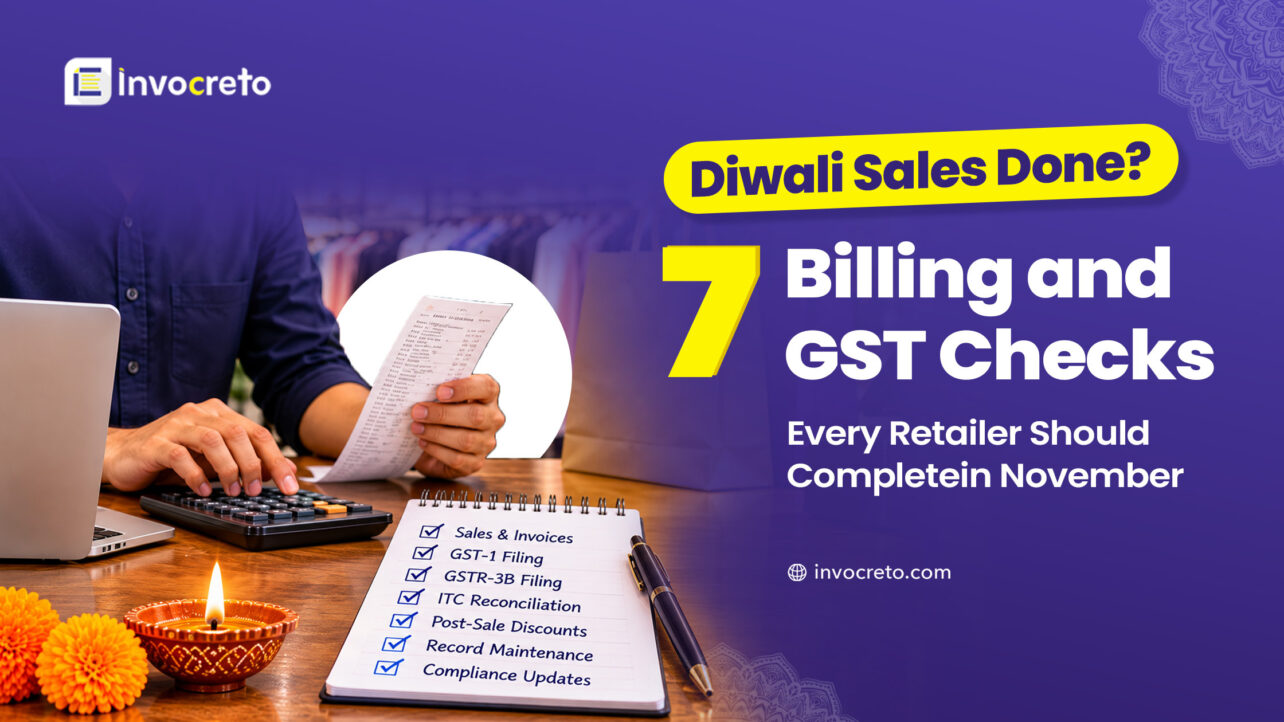
Diwali brings everything a retailer looks forward to: crowded stores, attractive offers, record-breaking sales and customers walking away with bags full of purchases. But once the festive lights come down, another important season begins the season of accounting, reconciliation and GST compliance!
During Diwali, billing counters move faster than ever. Staff members handle hundreds of transactions, discounts are applied, products are exchanged, online and offline orders pile up, and inventory moves rapidly. In the middle of all this excitement, small billing errors can easily go unnoticed.
A missed invoice, incorrect GST rate, unrecorded product return or mismatch between sales records and GST returns can create bigger problems later. November is the perfect time for retailers to review their festive-season transactions, clean up their books and prepare for smoother business operations.
Whether you operate a clothing showroom, electronics store, supermarket, jewellery shop or multi-location retail business, here are seven essential billing and GST checks to complete after Diwali 2026.
Reconcile Every Diwali Sale Across All Billing Channels
Your festive sales might have happened at the store counter, through WhatsApp, on your website, through marketplaces or via home delivery. The first step is to ensure that every sale has been recorded correctly. During Diwali, retailers often use multiple billing channels to manage customer demand. This can result in duplicate entries, missed invoices or differences between POS reports and accounting records.
What should you check?
- Match daily POS sales reports with your accounting records.
- Reconcile cash, UPI, card and online payment collections.
- Check whether every completed sale has a corresponding bill.
- Identify duplicate, cancelled or incomplete invoices.
- Match marketplace orders with actual dispatched and delivered orders.
- Verify that GST has been calculated correctly on taxable sales.
For example, imagine your store records ₹8 lakh in Diwali sales through its billing system, but your payment gateway and accounting records show ₹7.65 lakh. That ₹35,000 difference deserves investigation. It could be pending settlements, cancelled orders, refunds or simply missing entries.
Retailer tip: Create a daily sales reconciliation report instead of waiting until the end of the financial year. Small differences are easier to investigate while transaction details are still available.
Review GST Rates, HSN Codes and Invoice Accuracy
A busy festive season is no excuse for inaccurate GST invoices. Retailers selling multiple product categories must ensure that the correct GST rate and HSN classification are applied to each product. This is particularly important for businesses dealing in clothing, electronics, home appliances, cosmetics, footwear and gift items. An incorrect product tax rate can lead to underpayment or excess payment of GST.
Check these invoice details:
- Supplier’s registered business name, address and GSTIN.
- Invoice number and date.
- Correct product description and HSN code.
- Product quantity and taxable value.
- Applicable GST rate and tax amount.
- CGST and SGST or IGST, as applicable.
- Customer GSTIN for B2B transactions.
- Place of supply and delivery details, wherever required.
Also review your HSN reporting requirements. Generally, taxpayers with aggregate turnover exceeding ₹5 crore in the preceding financial year must report six-digit HSN codes, while those up to ₹5 crore must report four-digit HSN codes on B2B invoices, subject to applicable notifications and exemptions. CBIC’s invoice rules provide the prescribed invoice particulars.
Retailer tip: Review your product master in your billing software. Correcting an incorrect HSN code at the product level can prevent the same mistake from appearing on hundreds of future invoices.
Audit Diwali Discounts, Offers and Credit Notes
Buy One Get One Free, flat 20% off, cashback, exchange bonuses and additional festive discounts make Diwali shopping exciting. but, retailers must understand how these promotional schemes affect GST. The most important development to note this November is the GST amendment effective 1 November 2026.
Under the amended Section 15(3)(b) of the CGST Act, the earlier requirement that a post-supply discount must be established through an agreement entered into before or at the time of supply and specifically linked to relevant invoices has been removed. the supplier must issue a credit note under Section 34, and the recipient must reverse the attributable input tax credit for the discount to be excluded from the value of supply. This makes correct documentation particularly important for retailers and distributors offering post-sale discounts.
What should retailers do?
- Review all festive discount schemes.
- Separate discounts applied directly on invoices from post-sale discounts.
- Identify credit notes issued to customers and distributors.
- Verify the applicable GST treatment.
- Maintain supporting records for promotional schemes.
- Coordinate with registered B2B customers regarding corresponding ITC reversals.
Remember, a commercial or financial credit note that does not reduce taxable value is not automatically the same as a GST credit note that reduces tax liability.
Retailer tip: Do not issue credit notes casually just to adjust customer balances. Ensure that their GST treatment matches the actual transaction and applicable legal provisions.
Match Sales Returns, Exchanges and Refunds with GST Records
What happens after Diwali is just as important as what happens during Diwali. Customers may return clothes because of sizing issues, exchange electronic products due to defects or request refunds for cancelled orders. If your billing records show the original sale but your inventory and accounting records show a return, you need to reconcile the difference.
Your November return audit should include:
- Products returned by customers.
- Items exchanged for different sizes or models.
- Cancelled orders and refunded payments.
- Goods returned to suppliers.
- Credit notes issued against eligible sales returns.
- GST adjustments recorded in the relevant returns.
For example, if a customer purchases a television for ₹50,000 and subsequently returns it, ensure that the original invoice, return documentation, stock movement and refund records are appropriately connected. Under Section 34 of the CGST Act, credit notes can be issued in specified circumstances, including returned goods, deficient supplies and qualifying discounts. Applicable reporting deadlines must also be observed.
Retailer tip: Maintain a separate sales-return register. It makes it easier to identify which refunds have been processed, which credit notes are pending and whether inventory has been updated.
5. Reconcile Purchase Bills and Input Tax Credit (ITC)
Festive sales are only one side of your business. Retailers also purchase additional stock, packaging materials, promotional supplies and other business essentials before Diwali. These purchases can affect your Input Tax Credit (ITC). simply having a purchase invoice does not mean that every amount shown on it can automatically be claimed as ITC. You must check eligibility under GST law and reconcile your purchase records with the information available in GSTR-2B.
Complete these checks:
- Match purchase invoices with your purchase register.
- Compare eligible ITC with GSTR-2B.
- Identify invoices missing from supplier-reported data.
- Check supplier GSTIN and invoice details.
- Verify that goods or services were actually received.
- Review credit notes and debit notes from suppliers.
- Identify ineligible or restricted ITC and required reversals.
Pay special attention to large festive-season purchases. Missing supplier invoices or incorrect GST details can affect your working capital and return accuracy.
Retailer tip: Follow up with suppliers early when invoices are missing from GSTR-2B. Regular reconciliation helps avoid last-minute GST filing complications.
6. Check E-Invoicing, E-Way Bills and GST Return Readiness
November is also a good time to review your statutory compliance before the next GST filing cycle. Retailers with higher turnover, interstate supplies or multiple business locations should pay particular attention to e-invoicing and goods movement documentation.
E-invoicing check
Under the existing e-invoicing framework, registered businesses whose aggregate turnover exceeded ₹5 crore in any preceding financial year from 2017–18 onwards are generally covered, subject to notified exemptions.
If applicable, verify that:
- B2B invoices have valid Invoice Reference Numbers (IRNs).
- Required QR codes appear on invoices.
- Credit notes and debit notes are correctly reported.
- Invoice data matches your accounting records.
E-way bill check
Where applicable, reconcile e-way bills with actual goods movements. Check whether cancelled orders, returned goods, stock transfers and dispatched orders have appropriate supporting documentation.
GST return check
- Match outward supplies with GSTR-1.
- Reconcile tax liability with GSTR-3B.
- Review eligible ITC against GSTR-2B.
- Check debit notes, credit notes and amendments.
- Verify tax payments and outstanding liabilities.
Remember that e-invoicing is not mandatory for every retailer. Applicability depends on turnover, transaction type and exemptions.
Retailer tip: Do not wait until the GST filing deadline to discover missing invoices. Reconcile your sales and purchase data throughout November.
Review Inventory, Stock Transfers and Billing Software
After a successful Diwali season, your inventory might look very different from what it did before the festivities. Some products may be sold out, some may be returned, and others may be sitting in your warehouse waiting for the next sale. Your stock records should reflect what is physically available and what your billing system shows.
Complete a post-Diwali inventory audit:
- Compare physical stock with software stock reports.
- Identify damaged, missing and returned products.
- Record stock transfers between branches.
- Check slow-moving and unsold festive inventory.
- Reconcile purchase quantities with received goods.
- Review product prices and GST classifications.
- Verify that returned goods have been added back to stock where appropriate.
For multi-branch retailers, stock transfers deserve special attention. Transfers between distinct GST registrations can have GST implications even when both locations belong to the same business. This is also an excellent opportunity to evaluate your billing software. If your team is still managing festive transactions through spreadsheets and disconnected billing tools, November could be the right time to upgrade.
Simplify Your Post-Diwali Billing with Invocreto
Diwali sales bring more customers, more transactions and, unfortunately, more opportunities for billing errors. Once the festive rush settles, managing invoices, tracking transactions and organising sales records shouldn’t become another challenge. At Invocreto, we believe billing should make running a business easier, not more complicated.
That’s why we want to help retailers move towards a more organised and efficient invoicing process. With Invocreto, you can streamline your everyday billing workflow and spend less time managing paperwork and repetitive tasks.
Here’s how we can support your business:
- Simplified Invoice Generation: Create professional invoices and maintain organised billing records.
- Better Transaction Management: Keep your business transactions structured and easier to track.
- Reduced Manual Work: Spend less time on repetitive billing activities and more time serving customers.
- Organised Business Records: Maintain better visibility into your invoicing activities.
- Smoother Business Operations: Build a more consistent billing process for everyday sales and upcoming festive seasons.
Whether you’re reviewing your Diwali transactions or preparing for the next big sales season, Invocreto helps you take a more organised approach to billing. Don’t let post-Diwali paperwork slow down your business. Explore Invocreto today and make billing simpler, more organised and more efficient.
Conclusion: Diwali Sales Are Over. Is Your Billing Ready for What’s Next?
A successful Diwali is a great achievement, but managing what comes after the festive rush is equally important.
From reconciling sales and verifying GST invoices to reviewing credit notes, tracking returns and checking inventory, November gives you the opportunity to put your business records in order. Remember, good financial management doesn’t begin when a GST deadline approaches. It begins with accurate billing and organised records every single day.
At Invocreto, we’re here to make that process simpler. Get your post-Diwali billing in order today. Explore Invocreto and prepare your retail business for a smoother, smarter and more organised tomorrow.

No comments yet