

Have you ever purchased a product and wondered how much GST is included in its final price? Or have you seen a price mentioned before GST and struggled to calculate the actual amount you need to pay?
Understanding GST inclusive and GST exclusive prices can make a significant difference when shopping, selling products, preparing invoices, or managing business expenses.
Goods and Services Tax (GST) is an indirect tax applied to the supply of goods and services in India. However, the way prices are displayed can sometimes create confusion. Some prices already include GST, while others have tax added separately. The good news is that calculating both is relatively simple once you understand the formulas.
In this guide, we will explain the difference between GST inclusive and GST exclusive prices, show you how to calculate each with practical examples, and highlight common mistakes to avoid.
What Is the Difference Between GST Inclusive and Exclusive Prices?
The primary difference between these two pricing methods is whether GST is already included in the displayed amount.
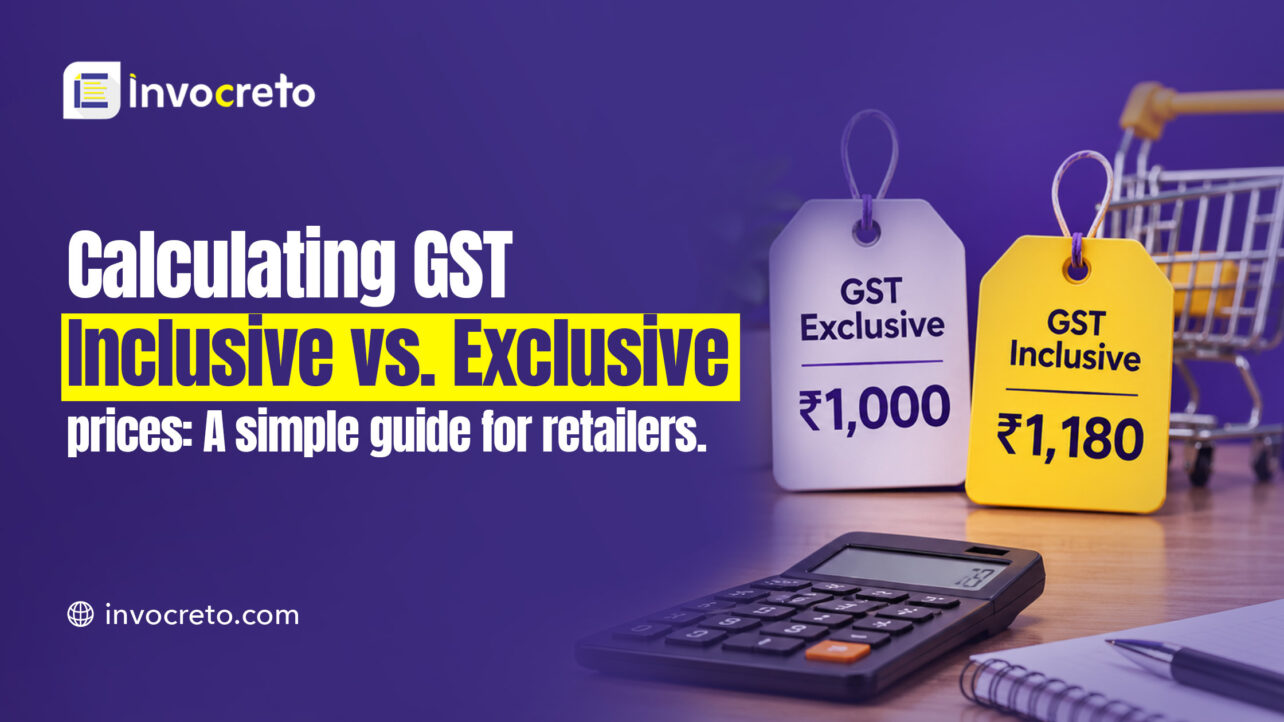
- GST inclusive price is the final amount that already contains the applicable GST. The customer pays this amount without adding the same GST again. For example, if a product costs ₹1,180, including 18% GST, the final amount payable is ₹1,180.
- GST exclusive price is the original product or service price before GST is applied. The applicable tax is added separately to determine the final amount. For example, if a product costs ₹1,000 before GST and attracts 18% GST, the final price becomes ₹1,180.
- GST inclusive = Original price + GST.
- GST exclusive = Original price before GST is added.
Both methods represent the same overall price when calculated using the same original value and GST rate.
How to Calculate GST on Exclusive Prices
Calculating GST on an exclusive price means adding the applicable tax to the original amount. This method is commonly used in quotations, invoices, and transactions where the price is communicated before tax.
GST exclusive price calculation formula:
GST Amount = Original Price × GST Rate ÷ 100
Final Price = Original Price + GST Amount
Example, suppose a product has an original price of ₹2,000 and attracts 18% GST.
Here is the calculation:
- Original price = ₹2,000
- GST rate = 18%
- GST amount = ₹2,000 × 18 ÷ 100
- GST amount = ₹360
- Final price = ₹2,000 + ₹360
- Final price = ₹2,360
Therefore, the final amount payable is ₹2,360, including ₹360 GST. The same formula can be used for different GST rates by replacing 18% with the applicable rate.
How to Calculate GST on Inclusive Prices
Calculating GST from an inclusive price is slightly different because the tax is already included in the final amount. Instead of adding GST, you need to separate the tax component from the total price.
GST inclusive price calculation formula:
GST Amount = Inclusive Price × GST Rate ÷ (100 + GST Rate)
Original Price = Inclusive Price − GST Amount
Suppose a product is priced at ₹1,180, including 18% GST.
The calculation would be:
- Inclusive price = ₹1,180
- GST rate = 18%
- GST amount = ₹1,180 × 18 ÷ 118
- GST amount = ₹180
- Original price = ₹1,180 − ₹180
- Original price = ₹1,000
This means the original product value is ₹1,000, while ₹180 represents the GST included in the final price. This calculation is useful when checking the tax component of a product, understanding invoices, or comparing prices.
GST Inclusive vs. Exclusive Prices: A Quick Comparison
Let’s compare both methods using the same original product value and tax rate.
| Particulars | GST Exclusive | GST Inclusive |
|---|---|---|
| Original price | ₹1,000 | ₹1,000 |
| GST rate | 18% | 18% |
| GST amount | ₹180 | ₹180 |
| Final price | ₹1,180 | ₹1,180 |
As the comparison shows, the final amount remains the same. The only difference is whether GST is added separately or already included in the displayed price.
Understanding CGST, SGST, and IGST
GST in India has different components depending on the nature and location of a transaction.
- CGST (Central Goods and Services Tax): This is collected by the Central Government on applicable intra-state supplies.
- SGST (State Goods and Services Tax): This is collected by the State Government on applicable intra-state supplies.
- IGST (Integrated Goods and Services Tax): This generally applies to inter-state supplies and certain other specified transactions.
For example, consider a taxable value of ₹1,000 with an illustrative GST rate of 18%.
For an intra-state transaction:
CGST at 9% = ₹90
SGST at 9% = ₹90
Total GST = ₹180
For an inter-state transaction:
IGST at 18% = ₹180
Total GST = ₹180
In both cases, the final amount is ₹1,180. The tax components differ depending on the transaction, but the overall GST amount remains the same in this example.
Why Is It Important to Understand GST Calculations?
Understanding GST calculations is useful in everyday financial activities, whether you are purchasing products, offering services, or managing a business.
- Better price understanding
Knowing whether GST is included in a displayed price helps you understand the actual amount payable and avoid confusion during transactions.
- Accurate invoice verification
Understanding the taxable value and GST amount makes it easier to check invoices and identify calculation errors.
- Improved financial planning
When you know the tax component of a purchase or service, you can calculate expenses more accurately and manage your budget effectively.
- Transparent transactions
Clear GST calculations help both buyers and sellers understand how the final price is determined.
- Easier accounting
Separating the taxable value from GST makes financial records, expense tracking, and reconciliation more organised.
Common GST Calculation Mistakes to Avoid
Even simple GST calculations can lead to errors if the wrong formula or tax rate is used.
Here are some common mistakes to watch out for:
- Adding GST twice: If a price already includes GST, adding the same tax again will increase the final amount incorrectly.
- Using the wrong GST rate: GST rates vary depending on the classification of goods and services. Always verify the applicable rate.
- Using the wrong inclusive formula: GST should be extracted using the formula that divides the inclusive amount by 100 plus the GST rate.
- Confusing GST with product value: The tax component and original taxable value should be understood separately.
- Ignoring the applicable tax structure: CGST and SGST generally apply to intra-state supplies, while IGST generally applies to inter-state supplies.
Simplify GST Calculations with an Online Calculator
Calculating GST manually is straightforward when dealing with one or two amounts. However, repeated calculations involving different prices and tax rates can become time-consuming.
An online calculator can make the process easier by helping you determine the original taxable value and GST amount without performing every calculation manually. For example, if you want to find out how much GST is included in a product’s final selling price, you can use the GST Inclusive Calculator.
It provides a convenient way to check inclusive pricing calculations, understand tax components, and reduce manual calculation errors.
Remember to select the correct applicable GST rate to ensure accurate results.
Conclusion
Understanding the difference between GST inclusive and GST exclusive prices makes calculating taxes much easier. While exclusive pricing involves adding GST to the original value, inclusive pricing requires extracting the tax from the final amount.
Both methods are important for understanding product prices, checking invoices, managing expenses, and maintaining accurate financial records. By learning these simple formulas and using the correct GST rate, you can avoid common calculation mistakes and make more informed financial decisions.
Whether you are purchasing a product, selling goods, or managing business transactions, having a clear understanding of GST calculations helps make every transaction more transparent.

No comments yet