

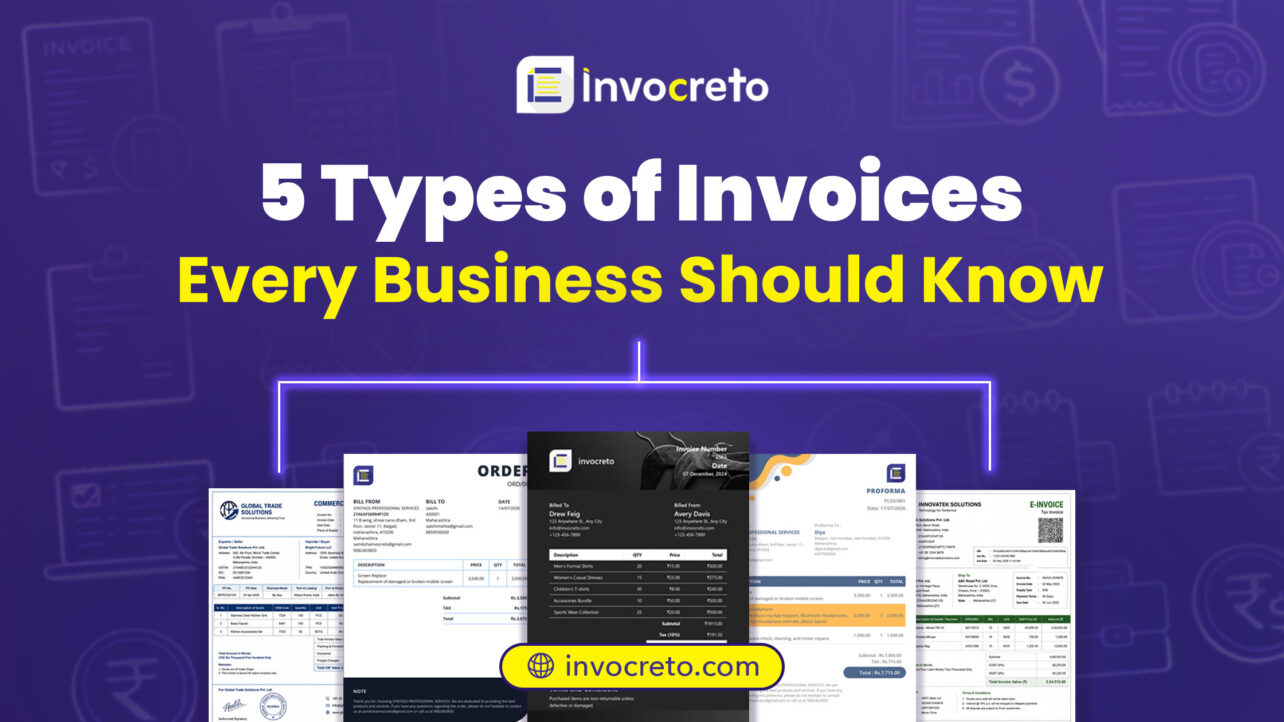
For businesses, getting paid is the goal and invoices play an important role in this process. Invoices help businesses request payment, keep track of sales and maintain clear financial records. Every transaction requires a well-written invoice to make it easier for customers to understand what they are paying for and when payment is due and right documents to keep operations organized, maintain accurate financial records.
Many business owners use terms like Final Invoice, Proforma Invoice, Order Invoice, Commercial Invoice, and E-Invoice, but often confuse one with another. All these types of invoices look similar, but each serves different purpose in sales process. In this guide, let’s understand each business document in simple language, show where it fits in sales cycle and help you decide which one to use.
Why different types of invoices Matter for business
Business documents are official records that help buyers and sellers communicate clearly during every stage of business transaction. They provide important details about products, services, prices, payment terms and delivery. Using right document at right time helps both businesses and customers stay informed and avoid confusion.
Invoices help businesses:
- Keep accurate financial records
- Avoid misunderstandings with customers
- Track sales and payments
- Simplify accounting
- Support tax compliance
- Improve customer trust
- Speed up payment collection
Using correct types of invoices at right time makes your business look professional and reduces errors. The five most commonly used invoices are:
- Proforma Invoice
- Order Invoice
- Final Invoice
- Commercial Invoice
- E-Invoice
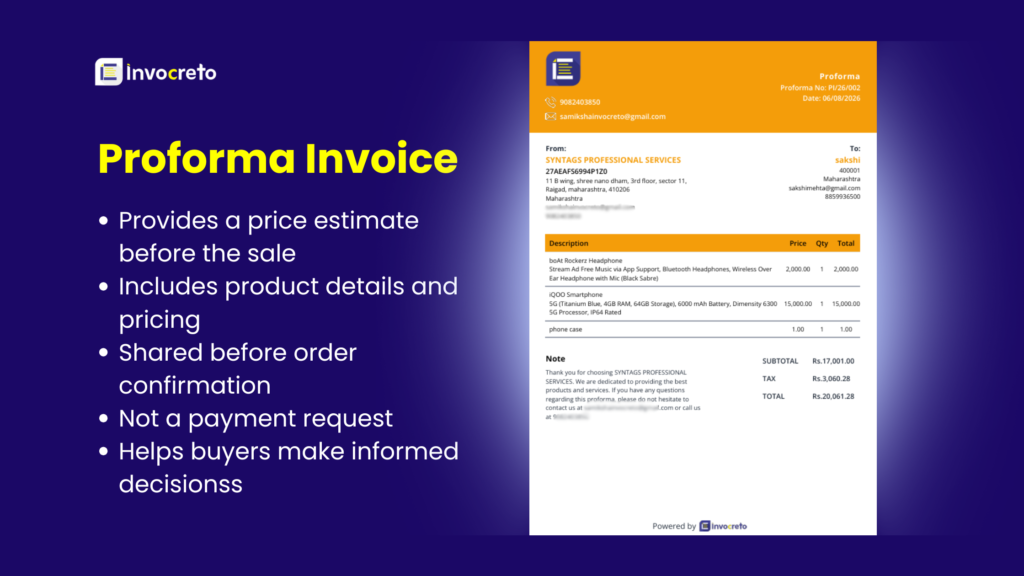
1. What Is a Proforma Invoice?
A proforma invoice is preliminary document sent to customer before goods are delivered or services begin. proforma invoice is not request for payment, it is estimated price that tells customer how much they can expect to pay for products or services before they place order. Businesses use proforma invoices to confirm pricing, quantities, taxes, shipping costs, payment terms and delivery details before sale is finalized.
Understand what is proforma invoice is in detail.
When is proforma invoice used?
- Before shipping products
- Before starting a project
- Before receiving advance payment
- During international trade
- When customers need approval before purchasing
- Information Included
What proforma invoice contains:
- Seller information
- Buyer information
- Description of products or services
- Quantity
- Unit price
- Estimated taxes
- Shipping charges
- Total estimated amount
- Payment terms
- Delivery terms
Proforma Invoice Example:
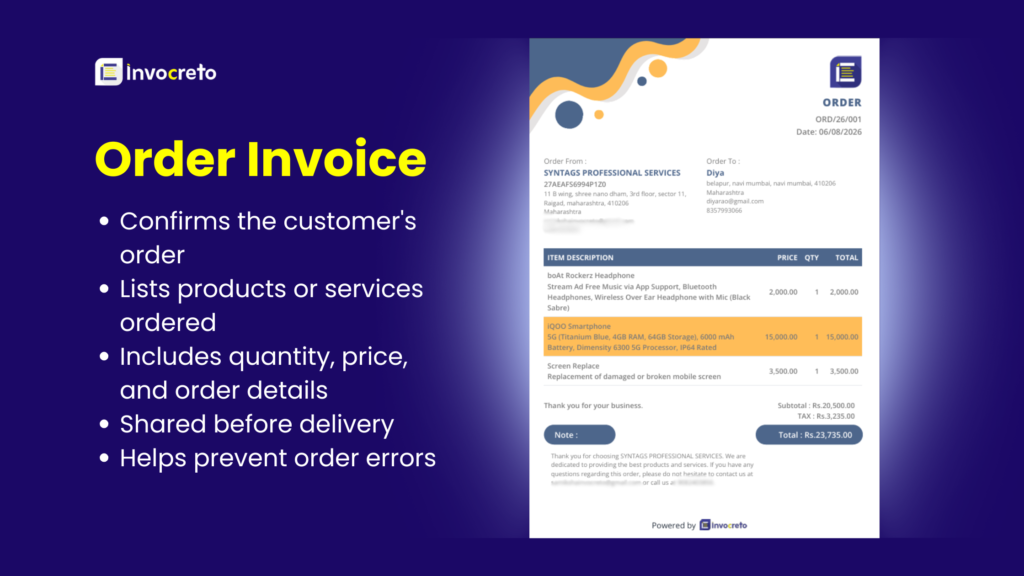
2. What Is an Order Invoice?
An order invoice is created after the customer confirms order and before products or services are delivered. Some businesses also call this Order Confirmation Invoice because it confirms that customer has accepted order. Proforma is only to provides estimated price, order invoice is created after customer agress to purchase products or services. It serves as record of confirmed order and helps both buyer and seller track transactions before delivery.
The Order Invoice confirms:
- Items ordered
- Quantity
- Agreed price
- Delivery schedule
- Payment terms
When Is an Order Invoice Used?
- The customer confirms the purchase
- Products require manufacturing
- Orders are customized
- Delivery takes time
- Inventory is reserved
Order Invoice Example:
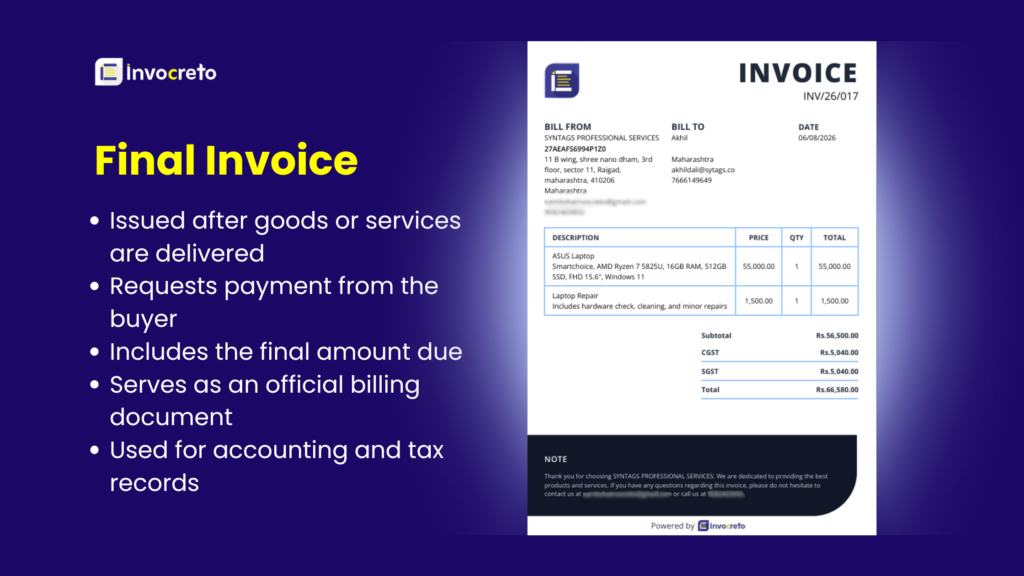
3. What Is a Final Invoice?
Final Invoice is the official payment request sent after the products have been delivered or the services have been completed. This is invoice customer uses to make payment, it includes final charges, payment terms and other important transaction details.
Final Invoice records the completed sale. It serves as an official financial document and becomes part of the company’s accounting records. It also helps businesses track payments, maintain accurate financial records, and support tax reporting.
When is a final invoice used?
- Businesses send a Final Invoice:
- After product delivery
- After completing services
- After finishing a project
- At the final project milestone
- Information Included
Final invoice contains:
- Invoice number
- Invoice date
- Customer details
- Product or service description
- Quantity
- Price
- Tax details
- Discounts
- Total payable amount
- Payment due date
- Payment methods
Final Invoice Example
4. What Is a Commercial Invoice?
A Commercial Invoice is used mainly in international trade. Whenever goods are exported or imported, customs authorities require a Commercial Invoice to verify shipment details. It contains important information about the products being shipped.
When Is It Used?
- Exporting goods
- Importing products
- Shipping internationally
- Clearing customs
- Information Included
Commercial invoice includes:
- Exporting goods
- Importing products
- Shipping internationally
- Clearing customs
- Information Included
Commercial invoice includes:
- Exporter information
- Importer information
- Product description
- HS Code (Harmonized System Code)
- Country of origin
- Quantity
- Unit value
- Total shipment value
- Currency
- Shipping method
- Package details
- Incoterms
- Signature
Benefits of Commercial Invoice
Required for customs clearance
Helps calculate import duties
Speeds international shipping
Reduces customs delays
Supports export documentation
5. What is an E-Invoice?
An E-Invoice (Electronic Invoice) is a digitally generated invoice that follows a structured electronic format. Unlike a PDF invoice sent by email, true E-Invoice is created in standardized digital format that can be automatically processed by accounting systems and, in some countries, government tax platforms. Many governments have introduced e-invoicing to improve tax compliance, reduce fraud, and simplify reporting.
When Is It Used?
- For digital billing
- To automate invoicing
- To comply with government regulations
- For faster accounting
- For electronic tax reporting
- Benefits
- Faster invoice processing
- Fewer manual errors
- Better record keeping
- Improved compliance
- Easier accounting integration
- Faster payments
- Reduced paperwork
Quick Comparison of Business Documents
| Document | Main Purpose | Used Before Delivery | Used After Delivery | Requests Payment |
| Proforma Invoice | Provides a price estimate before the sale | ✅ Yes | ❌ No | ❌ No |
| Order Invoice | Confirms the customer’s order details | ✅ Yes | ❌ No | ⚠️ Sometimes |
| Final Invoice | Official invoice requesting payment | ❌ No | ✅ Yes | ✅ Yes |
| Commercial Invoice | Required for international shipping and customs | ✅ Usually | ✅ During shipment | ✅ Yes |
| E-Invoice | Digital format of an invoice for electronic processing | ✅ Depends | ✅ Depends | ✅ Yes |
Business transactions often follow this sequence:
- Customer requests pricing: Business sends a Proforma Invoice.
- Customer confirms the order: Business creates an Order Invoice.
- Products are manufactured or services are delivered: Business issues a Final Invoice.
- If the transaction is international: Commercial Invoice is prepared for customs.
- If electronic invoicing is required: the invoice is generated as an E-Invoice.
Not every business uses every types of invoices. The exact process depends on the type of business, customer requirements, and local regulations.
Make Invoice Management Simple
Knowing the difference between different invoice types helps businesses use the right document at the right stage of a transaction. From proforma invoices for sharing price estimates to final invoices for collecting payments, each invoice has an important role in keeping business processes clear and organized.
As businesses grow, managing multiple invoices manually can become time-consuming. Using the right invoicing solution can help create professional invoices, maintain digital records, and simplify everyday billing tasks. With Invocreto, businesses can create and manage invoices easily while keeping their invoicing process simple, organized, and efficient.
Counclusion
Every business document has a specific role in sales process. A proforma invoice provides pricing before sale, an order invoice confirms customer’s purchase, a Final Invoice requests payment after delivery, a Commercial Invoice supports international shipping and an E-Invoice streamlines digital invoicing and compliance. Understanding purpose of each document helps businesses work more efficiently, maintain accurate records and provide better customer experience.
As your business grows, get help of invocreto invoicing software that simplifies document management, reduces administrative work and helps you get paid faster. By choosing the right document at the right stage of transaction, you can build smoother workflow, improve financial accuracy and support long-term business success.

No comments yet